How to Draw for Beginners Step by Step Easy
Do you struggle with a elementary circle from the get-go footstep of every tutorial? Do your straight lines proceed bending, no thing how difficult yous try? Do y'all seem to be unable to draw 2 points with a given distance between? Do your pictures look wrong fifty-fifty subsequently repeating carefully every single footstep from a detailed tutorial?
These bug may come from a lack of basic skills that are ignored when learning how to describe. In fact, these skills are obvious for someone who'due south been drawing a lot, but they too can be hands forgotten after a few years without a pencil in your hand. So are yous ready to take hold of up with the best cartoon exercises for beginners?
If you're looking for a pre-game motivational boost before taking on this challenge, cheque out the accompanying article, What's Your Excuse? Why Can't Yous Describe?
If y'all're drawing digitally, possibly you want your piece of work to expect as if it was created with pencil and paper. If this is the case, may we recommend one of the many Photoshop castor sets available on GraphicRiver, including this Classic Art Brush Pack.


one. Break the Directly Line
Your problem: yous're not able to draw a straight line/perfect circumvolve.


Step 1
Straight line drawing past paw isn't real. It exists only in vector, equally the shortest manner between two points. You can cheat and use a ruler, but most likely your manus will never learn how to describe a perfectly directly, long line. Even if it starts as something perfect, the longer you draw it, the more mistakes can be fabricated. What does it mean?
If drawing a long line is about impossible, we can use short lines that our hand is more than adapted for. This way it won't matter what tool yous use to draw direct lines; they'll usually come out pretty good. Just look at the film below. The shorter the lines, the closer to the original the picture show is.


Stride 2
Let'due south say you want to describe a flower similar the i below. You lot can come across it's built of a direct line, a perfect circle, and a few curves with precise angles. I judge you tin can depict it very slowly, very carefully, driving the lines from indicate to point, with your tongue stuck out and sweat on your face. Merely... why? Drawing isn't a job, it should be fun!


Step 3
Technical cartoon (straight lines, perfect circles) requires concentration. Information technology's about cartoon things exactly as they are. In that location'due south no space for inventiveness or personal fashion, since style comes from variety. Is information technology really what you lot want to exercise? Describe the same things exactly the same way all the time?
If you do, well, there's no tutorial for you lot. Because drawing—creation—is nearly keeping your paw relaxed while being focused on a last effect instead of creating a series of perfect lines. That'southward what you demand to acquire—how to keep relaxed, sketching chop-chop and carelessly. Permit'due south try to draw this bloom once once again, shall we? Just this fourth dimension, follow these simple rules:
- Divide the long lines into short ones.
- The more than curves, the shorter the lines.
- Touch on the paper very lightly; don't printing your pencil hard.
- Keep it fast!


Footstep 4
Wasn't that fun? If you narrow your eyes, it even looks quite done. Now, fill the spaces betwixt the lines with the ones it's lacking. The rules from the previous step still use.


Step five
You tin now stress the defined lines with a mark or pressing the pencil harder. This stride isn't necessary; yous tin can skip information technology.


Stride 6
It's done! It doesn't look exactly like the original, simply you lot can see some manner in information technology, a bit of your personal graphic symbol, a real work of your hands! You tin can notice it even looks more natural than the original, because nature isn't perfect. What's most important, once you cantankerous the boundaries, you can easily change everything!
Paradoxically, the less accurate your straight line drawing is, the more natural the results.


Step 7
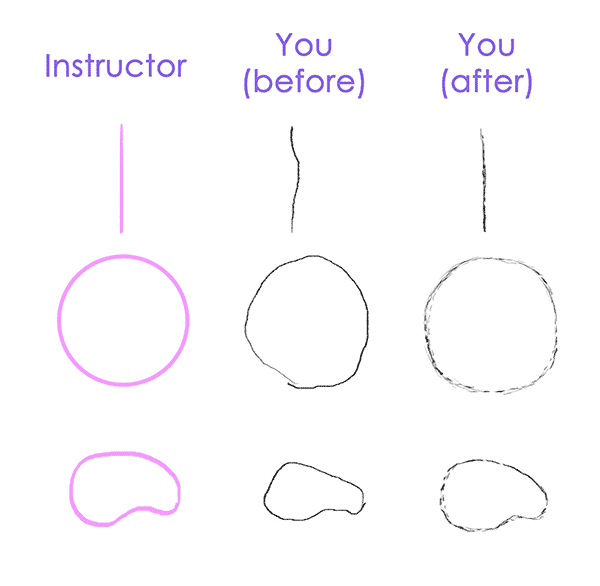
Now that you've learned how to draw a straight line, what should you practice?
- Split up the lines into short ones.
- Describe circles made of curt lines instead of long, e'er-angle ones.
- Draw lightly—this way, your little mistakes won't be visible.
2. How to Create Your Ain Mode of Art
Your problem: you feel you can only draw things other people have already created. Your drawings never look like something that's truly yours. If that'southward true for you, then it'south fourth dimension to learn how to make your own art style.


Footstep 1
So you can draw circles and straight lines, correct? That's not really skilful. You may be stuck in mathematical rules and technical drawing—you're great at repeating, but not creating. How can you aid yourself? Well, the first step of this tutorial is good for you too, only there'south another fob you can employ.
As I said earlier, style comes from diversity. If you're redrawing a movie carefully, line past line, without adding annihilation new (because it would be a mistake!), you lot can't end up with something different. The original wasn't yours, and your drawing is simply a copy. I don't say y'all shouldn't follow tutorials anymore; yous should just exist more than creative and—paradoxically—less precise when doing it.
How to lose a reasonable bit of precision? Let's kickoff with this simple exercise: describe a few simple shapes with your hand shaking, as if y'all were feeling nervous. Practice it until you feel your hand is relaxed.


Step 2
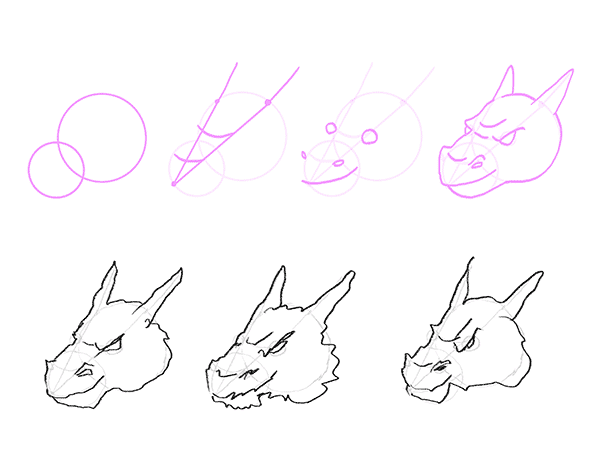
Let's endeavor this simple tutorial now. Do this the same mode as usual, but in Footstep iv shake your hand when drawing the final lines. Describe a few of these heads, irresolute the level of twitch every time.


Step 3
Surprised? Every head looks unlike than the original, but you can recognize what y'all've only drawn. Also, you used the aforementioned proportions for them all, yet none of them looks identical. How could it have happened?
When y'all were learning how to write, your teacher wanted y'all to repeat lines from a template. Yous were spending a lot of time cartoon (not writing) every single letter as if it was a small masterpiece. Then, with fourth dimension and experience, you developed your own character of writing, your ain fashion. Your letters look different than mine or your friends', simply still, nosotros can all read what you write. Your style changed because you wanted to write fast—to write down your thoughts, not to describe perfect but meaningless letters.
Utilize this rule to your drawings. Recall about what y'all desire to reach, non about the lines. Depict fast, and your personal, unique hand movement will have a take chances to shine.
Pace 4
There's another thing that adds up to your mode: creativity. Practice the same tutorial in one case once again, this time changing the stride results to your needs. You're learning how to depict a dragon's head, but what if dragons in your listen have longer mouths? No problem! You don't need to detect more drawing exercises for beginners for that. Merely adjust the rules to your needs.


Step 5
Alright, then you at present know how to make your own art style. What's next for practice?
- Try to draw things from your environment with shaky, careless lines, without worrying most the effect.
- Sketch a lot! Don't call up about the event, merely let your paw practice its natural movement.
- When post-obit tutorials, stay artistic—change lengths, shapes, distances, and see where information technology takes yous.


iii. How to Measure and Draw Proportions
Your problem: your proportions always expect off. You feel unable to draw a given distance without using a ruler or other tools.


Step 1
Incorrect proportions are a huge trouble for an aspiring artist. Luckily, it tin can exist overcome if yous don't ignore it. Beginning, what are the proportions, actually?
Proportions aren't a altitude measured in some unit of measurement. They define the location of an element relative to others. That means that if you want to draw the whole picture (set of elements) two times bigger, all the distances demand to be doubled too.


Step 2
Let's railroad train our optics to see and redraw proportions. First, try to redraw this motion picture, but two times smaller:


Pace 3
Now, have a ruler and check if you got it right: the distance should be two times smaller than on the screen. And, how'due south your result? Probably not very skillful, if y'all're reading this cartoon proportions tutorial. Discover that the circles should be 2 times smaller besides, and that seems near impossible: how can you describe a circumvolve that's twice equally large, if yous don't even know the original size?
The answer is that nosotros need at least two elements to talk about relativity. No matter what size the first element is, it can't be unproportional, if at that place'due south merely 1! So allow'south attempt once again. Describe only the first circle.


Step four
Now imagine ii lines coming from the centre of the circle. At that place'south a third imaginary line connecting both circles. Can yous see what angle it creates? Describe this line on your picture, without adding the second circumvolve for now.
If you accept issues with seeing the angle, try to divide the right angle into thirds, so every third into thirds again. Each of them is 10 degrees.


Pace 5
We need to set the distance now. How many circles can be put between both centers in the original? Use this relationship to your picture. For the start time, it's best to print the original and draw the other circles physically. Later on, y'all tin can try only pretending you're drawing them (keeping the pencil right above the paper/screen and seeing the circles in your heed).


Step 6
It's nigh washed! Now we need to cheque what the size of the second circle is in relation to the large one. A good method for this is to imagine the second circle inside the start one to conspicuously encounter the proportions.


Stride 7
Washed! Y'all can use the ruler once once again to meet how accurate it is. This method is really good when your optics aren't trained to see proportions yet, and with time you may not need to draw the guide elements anymore.


Step 8
You've done it! You went through all the steps in learning how to draw proportions. For more practice, do the post-obit:
- Learn to see proportions everywhere. Look around and ask yourself: How long are my fingers in comparison to the palm? How many heads can be put in a row forth my canis familiaris'southward back? What chemical element of the face could fit perfectly between the eyes? This grooming tin can be done in your spare time, and it increases your concentration. Also, with time, your eyes will learn to do it without your awareness!
- If you have problems with recreating sizes (for instance, you draw 2 identical circles and they're always different), don't avoid practicing it. Draw these two circles every bit long as you tin can draw them identically, and and then try the same with triangles, squares, and so on. This problem must be solved before doing whatever other tutorial, since it'due south the base of other skills.
- The Internet is full of simple, step-by-step tutorials that don't teach any existent drawing skills, but they're bang-up for practicing proportions. Start with the simplest pictures for children and move on when you feel more confident. Again, don't go farther before establishing these basic skills. Cypher strong can exist built on a weak base.


four. Costless Your Hand
Your problem: you discover cartoon parallel or concurrent lines very hard. The 2d line always goes in the wrong direction somehow.


Pace ane
This happens sometimes when you're trying as well hard. You want to be precise and, every bit a result, you draw slowly and advisedly, giving your mitt more than time for mistakes. Try to describe both lines fast: does it change anything? If yes, well, I'grand glad I could help! If no, a piddling preparation may exist needed.
Drawing snakes is the greatest and the most complex preparation I can remember of. Information technology lets you practice proportions, planning lengths, changing size and angles, and, most chiefly, information technology teaches your hand how to move gracefully. If you're reading this paragraph, you probably take problems with snakes too—they're thick at 1 point, then thin and thick over again, totally messy and incorrect. But we tin can fix information technology!
First with a row of circles, each 1 smaller than its predecessor. Finish the row with a single indicate.


Step 2
Connect the corresponding ends of the diameters. A simple snake is done! Of course, there'south more to learn.


Step 3
Now draw a series of the same circles, simply changing their positions vertically too.


Stride 4
Connect them again.


Step five
Let's increase the difficulty level. Do the same as before, simply now exit bigger spaces betwixt the circles.


Step half-dozen
Connecting the circles may be harder at present, because you need to depict the arches. This is the bodily practice. Draw the snakes, long and short, directly and curled, using bigger spaces betwixt the circles every time you see you lot got it right. If you lot practise this long enough, your hand should learn the proper motion.


Footstep 7
What to practise?
- Snakes! Draw a lot of them; they're fast and easy;
- Draw a serial of parallel lines and waves as fast as possible. Let your hand feel it'due south gratis!
- Draw wavy lines when watching TV or reading articles on the Internet. Information technology doesn't matter what you lot're drawing, only teach your manus how to move freely and carelessly.


5. Larn What Things Are... And Why They Are
Your trouble: you can't draw from imagination. Everything goes right when you follow a tutorial, but and so you can't call back the steps, or there's only one pose that turns out OK.


Stride 1
Even though the all-time drawing exercises for beginners won't assistance you hither, you'll be glad to hear this isn't as big a problem as information technology seems. Yous simply need to alter your mental attitude. The trouble is that you learn how to describe lines instead of what the object is. At that place are two kinds of information:
- Matrix (raster): Where'south the point? What'south it connected to? What's the distance betwixt them? How many of them occur in a given area?
- Vector: What'southward the point for? What's this point part of? What does this set of points exercise? How does it influence the other elements?
Matrix information is a template to create the same thing all over once again. Information technology'south hard to remember, and it'southward useful only in a few cases. Vector information is scalable. It means that when atmospheric condition change (different pose, size, manner), the elements adjust to them, because they're attached to proportions, not position. Here'southward an example:
Matrix Dog Caput Information
- C1 - nose
- C3 - center
- C1-E3 - rima oris
- A3-E5 - caput (etc.)
Vector Dog Head Information
- The head is fabricated of two circles: a "brain case" and a mouth.
- The mouth is a bit higher than the eye of the brain instance.
- The eye is circular, and it starts at the middle of the brain example, touching the mouth.
- The nose is on the tip of the mouth, and it's as big as the eye (etc).


If you'd like to change something, for example open up the oral cavity, matrix data fails. Information technology'southward fixed, scalable only in terms of size, and it's even more useless when you want to create a pose in 3D space. How tin can you learn in vector, then?
Step ii
Have an object and analyze it. There are two ways of thinking y'all can employ at present (I'll utilise a glass equally an case):
- The glass is fabricated of a rectangle, then there'south a apartment triangle under it, a quite long line, and a flat triangle again.
- The glass is fabricated of an oblong container with a circular department where wine is poured. The upper part of the container can be bent to the inside, to stop the bubbling from slipping away. The bottom of the container melts gently into a thick leg. The leg then melts into a circular support.
What practice yous think? Which way improve describes the essence of a drinking glass? The first i is fast and bully when yous start your adventure with drawing, but it will only allow yous draw this particular position. You may effort to go into a 3D world, acquire perspective, add together some motion, and suddenly it turns out you don't really know how to depict a glass.


Pace 3
Another example is beefcake. You may learn the curves of a body in one pose, simply it doesn't tell you anything near what the same body looks like when running/sitting/fighting. A simple "why" has never been that powerful. Why is this part bulging? What's information technology used for? Why is information technology long/short? Why is this part connected to some particular one?


Pace four
What to do?
- Terminate thoughtlessly copying the lines you're seeing. Effort to understand the object as a whole. If you understand why information technology's built and drawn similar this, you'll be able to modify information technology and create something that'south truly yours, without breaking the rules.
- Clarify objects even when you're non cartoon. In a queue, in a bus, waiting for someone—expect around and enquire yourself: why does it look similar this? What's its purpose? With every answered "why", y'all're extending a huge base of vector data in your caput. You'll be surprised how much it helps!


Now You're Ready to Depict!
If you've followed the tutorial carefully, after some practice you should be able to follow intermediate tutorials flawlessly. While these drawing exercises for beginners may seem boring, they're essential and need to be learnt. If you tried them and they seemed piffling, that's great, yous're gear up! But if you had some problems, it'south really better to finish hither and practice until you overcome them.
More Useful Drawing Resource
If yous desire the best uncomplicated drawing tutorials and exercises for beginners, stick right here on Envato Tuts+! Our instructors take put together many helpful guides that will assistance you develop your skills. Here are just a few to become you on your fashion:
Did you find this mail useful?

Source: https://design.tutsplus.com/articles/i-want-to-draw-simple-exercises-for-complete-beginners--vector-20583
0 Response to "How to Draw for Beginners Step by Step Easy"
Post a Comment